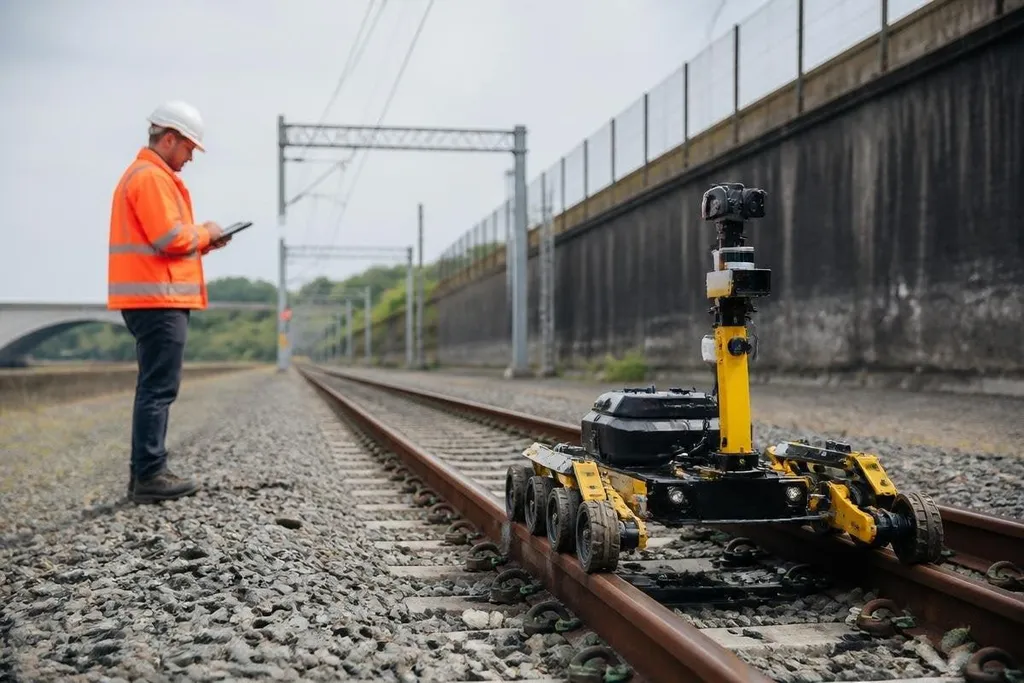
Railway robots are moving into work that is slow, risky, or hard to reach by hand. Their value comes from doing repeatable jobs around tracks, trains, tunnels, bridges, and stations while people stay at a safer distance.
The case for them rests on the work itself. Rail operators need regular checks, clear records, and repairs that cause as little service disruption as possible.
The work rail robots can handle
Inspection is the clearest starting point. The system can carry cameras, thermal sensors, or other inspection equipment along a track or around a train. It records the condition of rails, fasteners, wheels, cables, or structures for later review.
That does not remove the need for engineers. It gives them a more consistent set of images and measurements to study, with the location of each finding tied to the inspection run. A small defect can then be compared with earlier records instead of being judged from memory.
Some robots work on the track. Others move through tunnels, climb structures, inspect overhead equipment, or travel inside depots. The right design depends on the surface, the distance, the sensors, and the amount of human control needed.
Safety changes the calculation
Railway inspection can place people close to moving trains, electrical equipment, uneven ground, and confined spaces. The first look can happen before a worker enters, or during a planned service window.
Remote operation matters here. A technician may guide the robot from a control point while watching its camera feed. More autonomous systems can follow a known route and stop when they detect an obstacle or lose contact with the operator.
The robot still needs a safe failure response. It should stop in a known place, report its position, and allow a worker to take control. A machine that keeps moving after a communication fault creates a new railway hazard.
Railway operators also need clear rules for work near live lines and active routes. A robot's usefulness depends on those rules as much as its motors and sensors.
Better records can lead to better repairs
A single inspection matters less than a record that can be compared over time. Repeated runs can show whether a crack is growing, whether a component is shifting, or whether a repair has held.
That information can help maintenance teams plan work before a fault interrupts service. It can also reduce unnecessary part changes when a component remains within its accepted limits. The benefit comes from the link between inspection data and a decision made by a qualified person.
This is where readers who follow automation need to separate working systems from polished demonstrations.
A clean test run says little about a railway robot’s work across rough track and changing weather. Robot24.com railway robotics coverage can tie each claim to the machine, test setting, task, and date before the next section examines practical limits.
The limits are practical
Railway environments are difficult for machines. Track surfaces can be uneven, weather can change sensor readings, and dust or water can affect moving parts. A tunnel robot may also need to keep working when wireless contact is weak.
Data quality creates another limit. A camera can record a defect, but someone still has to decide whether it needs repair. An automated warning may point to the wrong place, miss a small fault, or flag a harmless mark. The system needs checks against known conditions before operators rely on it.
Cost matters too. A railway company has to pay for the robot, sensors, control software, training, storage, and maintenance. A small operator may get more value from a shared inspection service than from owning a machine.
I'd put inspection records ahead of full autonomy when a railway is choosing its first robot. Reliable data, clear operator control, and safe recovery matter more than removing people from every task.
A practical buying checklist
Before a railway team selects a robot, it should check:
- Work area: Can it run on the actual track, floor, slope, tunnel, or train surface?
- Sensor result: Does it measure the defect the team needs to find?
- Operator control: Can a person stop and guide it when conditions change?
- Failure response: Where does it stop after a lost signal, low battery, or blocked route?
- Data record: Can each image or measurement be tied to a location and inspection date?
- Service plan: Who repairs the robot, replaces its sensors, and trains its operators?
Railway robots will earn wider use when they fit existing safety rules and produce records that maintenance teams can act on. The next question for each operator is narrow and practical: which task keeps people closest to danger while producing work a robot can check reliably?